Operation Cronut

By: John Malik
By now the entire food world has heard of and salivated over a Cronut. It’s a doughnut made from croissant dough, says Chef Dominique Ansel, owner of Dominique Ansel Bakery in New York’s SoHo district. Now Chef Ansel is no flash in the pan; he was Daniel Boulud’s pastry chef for many years and if I were in NYC, I would happily spend a couple hours in his bakery. I first read about this on Twitter on or about the 15th of May and by the 23rd, Chef Ansel was on the Today Show, Fox News, CBS and Judge Judy.
Judge Judy: “Now Chef Ansel, is this a croissant masquerading as a doughnut or am I looking at a doughnut masquerading as a croissant?”
Chef Ansel: “Madame Judy, zah bailiff has eaten zah evidahnce.”
But seriously folks…it looks like Chef Ansel gave one short interview to Grub Street which almost every food blogger in the free world then breathlessly parroted, right down to the “it’s impossible to fry croissant dough” and the “secret temperature” of frying. What the hell? Did Chef Ansel invent a new scale of heat to rival Kelvin? OK let’s all take a deep breath and relax for a second because John and Amy are on this like a cheap suit. My first reaction; I’ll bet all those folks standing in line for a cronut (he only makes 200 a day and sells out in a matter of hours) were also on a gluten-free fad only last week. My second thought was; I gotta try this. Now keep in mind that croissant dough is full of butter so frying it presents a problem. If the dough is room temperature then so is the butter and that means the butter is a warm breath away from separating into its three components: water, milk fat and butter fat. Chef Ansel has several photos on his website and there’s plenty circulating around so after looking closely at these two, I’d say we’re looking at two different doughs.
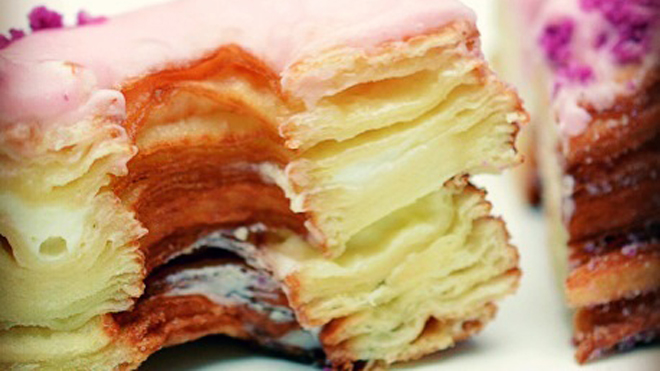
This is his first flavor but notice how the interior layers of dough look under-cooked? The layers also look as if they’ve been laminated together with egg wash. This also looks like a danish dough to me and Amy. Danish dough is similar (ingredient wise) to croissant dough but has egg and water in it and in a commercial kitchen, the butter is cut in using a food processor then the dough is rolled three to four times.
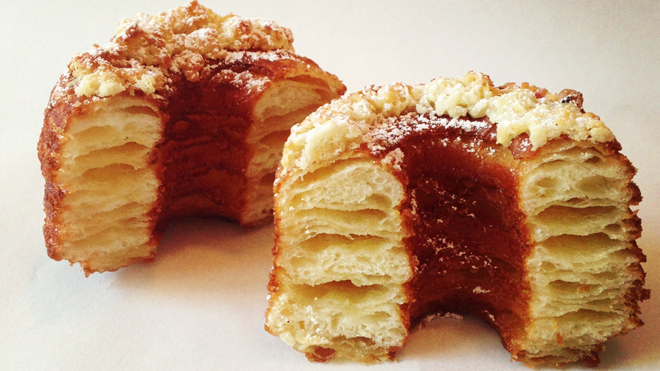
This is the current photo on Chef Ansel’s website. Notice the difference in the dough? The dough has been proofed longer, the layers aren’t quite so thick and it doesn’t have the pastry cream either. I think this photo was taken by Chef Ansel’s photographer and the above photo was taken by Fox. Perhaps if Chef Ansel had sliced that cronut himself, he may have looked at it and decided it was under-cooked and used another one. This one also looks more professional, the ‘nut looks as if it wasn’t rushed.
So after reading all the cronut stories we decided to make some. Before you embark on this recipe you’re gonna need an electronic thermometer, fresh yeast and a doughnut or biscuit cutter, everything else is fairly common. Amy took the route of pastry dough and I made croissant dough. I started with the recipe out of one of my favorite cookbooks, Baking with Julia. The croissant dough recipe is attributed to Esther McManus. Making croissant dough is not technically challenging but it is time consuming and you’re gonna be in for an upper-body workout.
- 1 Tablespoon Yeast
- 1/3 Cup Sugar
- 2 Teaspoons Salt
- 1 Cup +3 Tablespoons Warm Milk (100-105 degrees)
- 3 & 3/4 Cup King Arthur AP Flour
In the bowl of your stand mixer place the milk, sugar, salt and yeast and whisk together. Then cover with a clean towel and leave it alone for thirty minutes. The yeast will wake up, start eating the sugar and will expel CO2 and you should have a bubbly layer on top. If not, throw it out and start over. If your milk is too hot you’ll kill the yeast so be precise with your temperature. Now add all the flour to your bubbly yeast mixture, place on the mixer and using the dough hook, mix slowly until the dough forms a nice ball then wrap it in plastic wrap and place in the fridge, overnight.
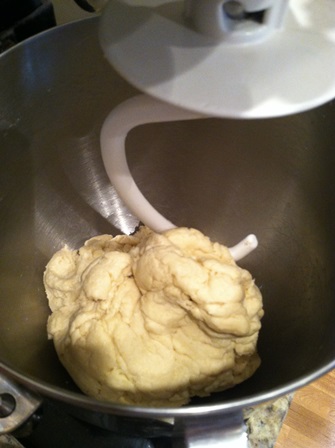
Flour and yeast mixture ready to be removed from stand mixer
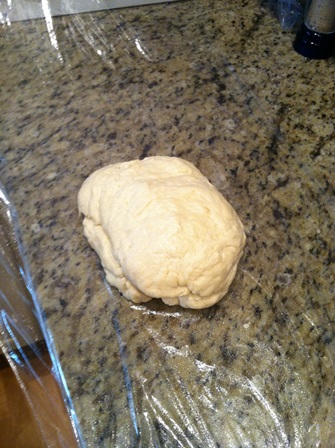
I kneaded this by hand for a couple minutes then placed on a big stretch of plastic wrap, covered and place in the refrigerator overnight.
Clean the bowl, find your paddle attachment and let’s get to the second part; the butter.
- 4 and 1/2 sticks Unsalted Butter, COLD, cut into quarters
- 2 Tablespoons AP Flour
Blend these two ingredients in the mixer until you have a nice, smooth paste. This should only take about thirty seconds. Then spread this onto a big sheet of plastic wrap, smooth into a rectangle, cover and refrigerate.
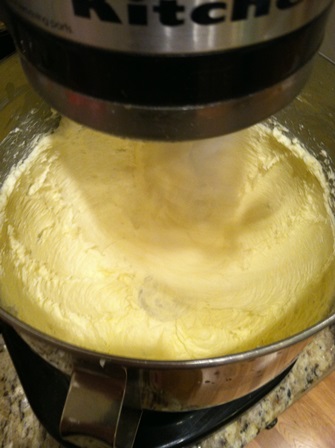
Whip the butter and flour using the paddle attachment.
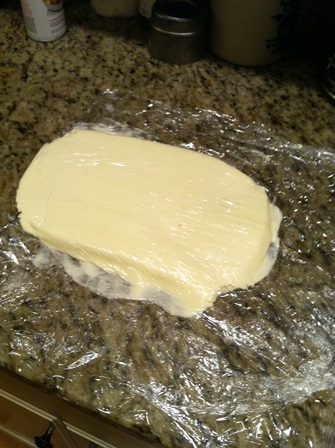
Take another big stretch of plastic wrap, scrape all the butter onto it, shape it into a rectangle about 12 x 8, cover with the film then place in the fridge with the dough.
Day two. Now comes the hard part.
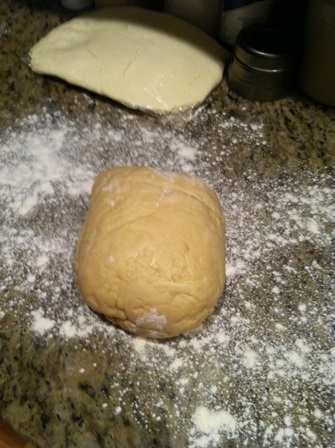
Sprinkle some flour on the (clean) counter, place the dough on it and get to work. The dough has to be rolled out into a rough rectangle approximately twice the size of the butter shingle.
This is how Popeye got his massive forearms. He was actually a baker in the Navy before he became a professional bar brawler.
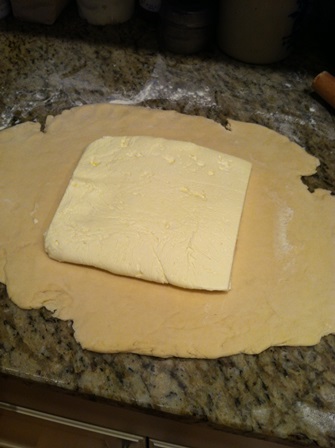
And this is your goal. The cold butter should fit neatly onto the surface of the dough.
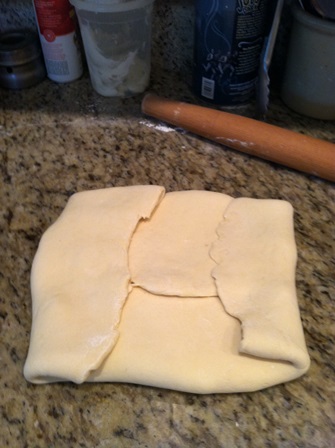
Now fold the edges over the butter like so…
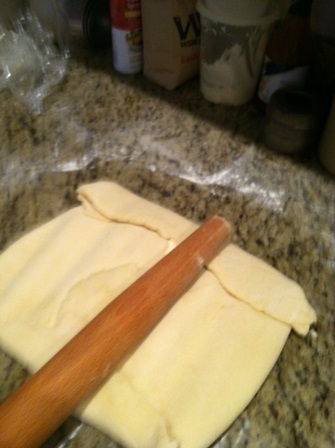
And get back to work! I pounded the dough briefly before taking up the rolling.
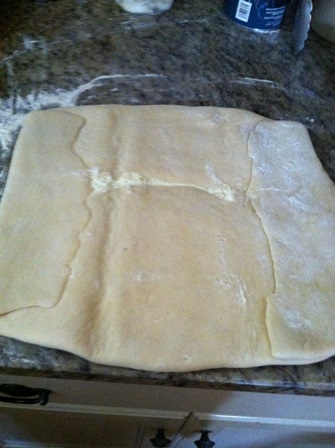
This is what you’re aiming for. Work quickly because all that friction will heat up your butter and the butter needs to stay cold THE ENTIRE TIME!
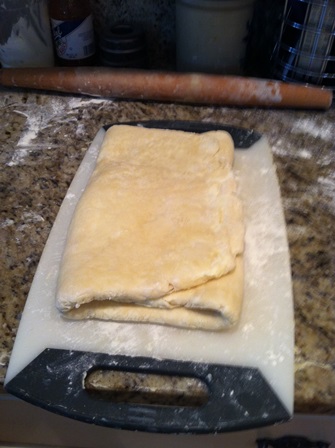
Now fold the dough into thirds, place on a flat surface, cover with a clean towel and place into the refrigerator for about 30 to 40 minutes to chill the butter. Then…
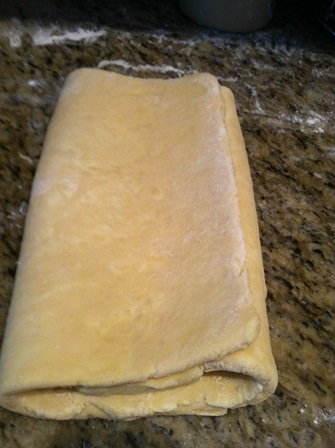
Place the dough back on the counter, get that rolling pin and get to work! You’re going to do this step FIVE times, no cheating either, got it?
Roll…
Fold, then refrigerate…
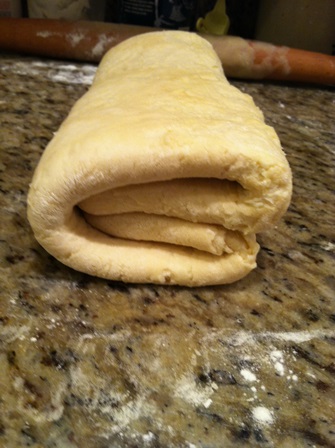
Then for the final (#6) turn fold the dough over in fourths, just like this…
and roll again!
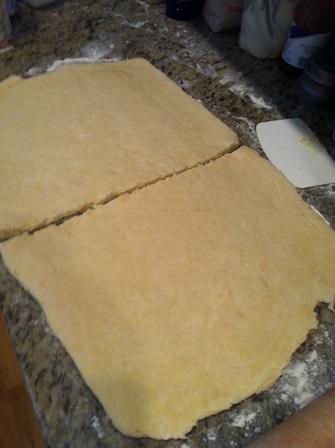
No time to rest on your laurels because the dough heats up and the butter is in danger of breaking. Now what I did was separate the dough into two portions — one to make croissants and the other for the doughnuts. That way if I screwed up the doughnut part at least I would have some croissants.
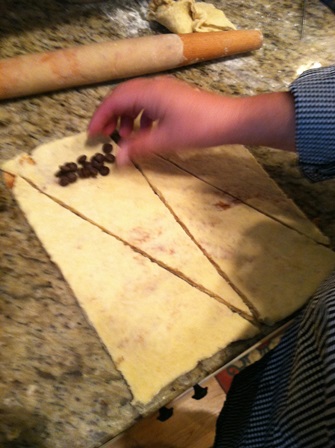
I sprinkled a tablespoon of cinnamon, folded then rolled again then cut the dough into these long triangles. Amy sprinkled some chocolate chips at the wide part…
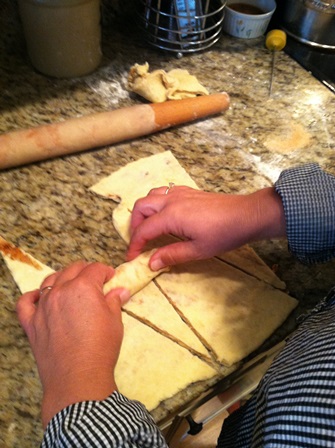
then rolled them up…
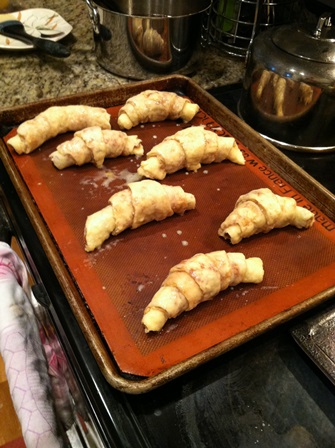
If you like, you can roll them out then twist the edges towards each other for a more “crescent” appearance.
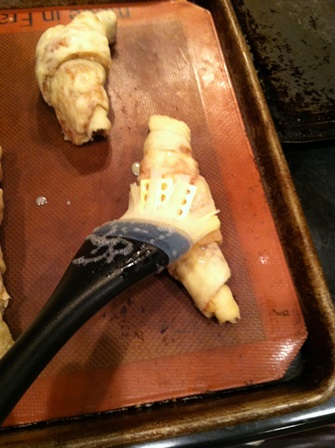
Brush with a little egg wash then into a 375 degree oven (middle rack, not the bottom) for about 25 minutes or until an internal temperature of 190 is reached.
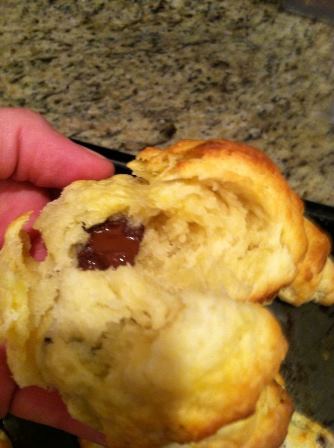
Needs more chocolate.
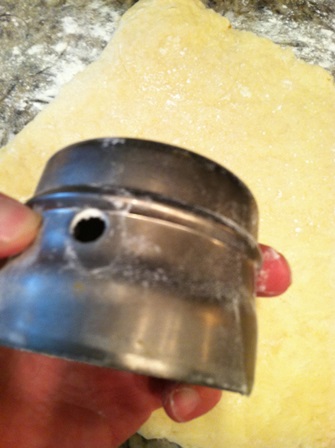
Now on to the cronuts. While I was fooling with the croissants the other batch of dough went into the fridge. Then when I was ready and had hot oil, I floured my antique doughnut cutter. This thing has an airhole in it and I can just imagine some burly baker telling his apprentice to keep his fingers off it.
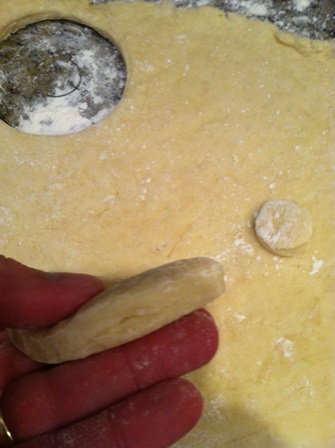
and I cut the ‘nuts into half inch portions.
Now I’m gonna spare you all the temperature combinations I went through but needless to say it took me several rounds. So here’s what I found was best. Cut the ‘nuts, place on a sheet pan, cover with a clean towel and allow them to proof for thirty five minutes or so, that will give them a good rise. Now place the ‘nuts back into the fridge and chill to 50 F. Then fry in 340 to 350 degree oil. The reason being that if the dough is close to room temperature then the butter will break as soon as it hits the oil and then you’ll end up with a soggy mess.
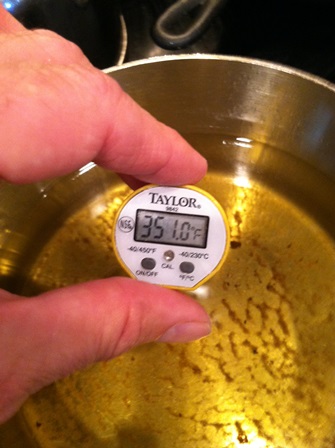
Close enough for government work.
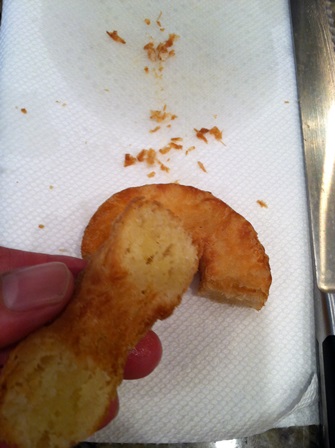
And here’s what I came up with. Drizzle with a little chocolate syrup and yes, it was delicious. Was it “Oh My Lord. That’s Amazing!”? Uh…Not really. Is it what I think Dominique Ansel is doing? Nope. His are larger and his dough is surely leaner in butter than a croissant dough. If you want to try this I would suggest adding sugar, cutting a larger ‘nut and using a lower oil temperature (325-330) so you don’t burn the sugar in the dough. Make sure the ‘nuts are cool, about 50-55 F, got it?
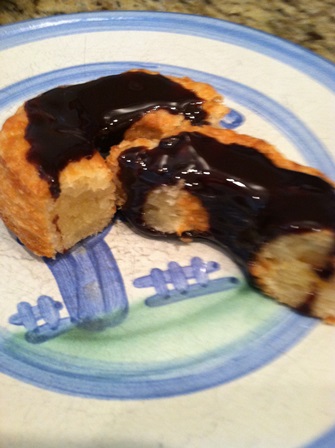
And here’s the finished product, certainly delicious and unlike a yeast-risen doughnut, quite fragile. It’s not Knock My Socks Off amazing though.
My dear wife took another swipe at this and started with a puff pastry dough. This is a quick version that she’s used many times and it’s right out of Saveur Magazine.
- 1& 1/2 cups King Arthur AP Flour
- 1 & 1/2 cups King Arthur Cake Flour
- 1/4 Cup Sugar
- 1/4 teaspoon Salt
- 3 Sticks Butter, COLD, cut into small, 1/4 inch cubes
- 2/3 Cup Ice Water
Over a large bowl, sift the flour, salt and sugar together. Cut the butter into the flour using a pastry cutter, or two forks or your hands, just like if you were making biscuits. You can use a food processor too but remember to make sure the butter is cold and I would also chill the blade and bowl as well. Intersperse some of the chilled water when you’re mixing in the butter. The finished product should feel like pie dough. Once the butter and cold water is incorporated, place the dough onto a big stretch of plastic wrap, refrigerate and chill overnight. Now comes the hard part. Yep, ya gotta roll it out to a rectangle, fold it into thirds, chill then roll again. At least four times. Just like in the previous photos, floured counter and all. And no cheating! An old school puff pastry dough would be made using the technique of shingling the butter then rolling and folding, just like I did for the croissant dough.
After you’ve done this all day, feel free to skip that gym visit until you’ve eaten one of these.
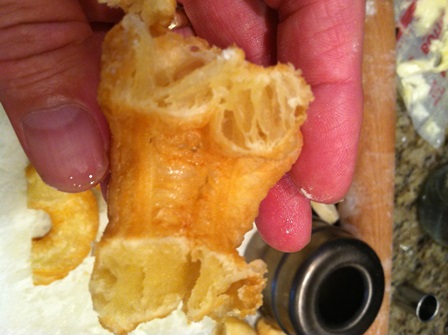
Amy rolled out two very thin layers of dough, brushed egg wash on one layer, placed the other layer on top, rolled again, chilled the dough for about an hour and only then did she cut the cronut. After using the same frying technique described above, this is what Amy got.
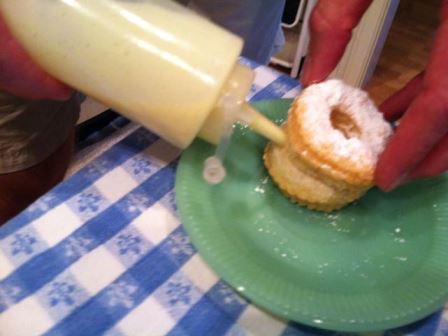
A squirt of vanilla pastry cream and a sprinkle of powdered sugar…
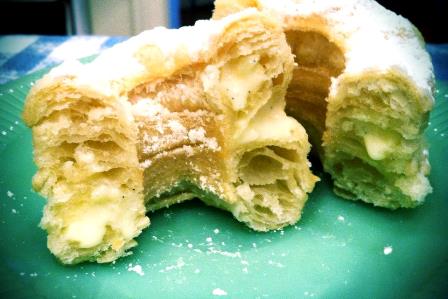
And here we go. Pretty close, right? Yet Amy and I both agreed that we wouldn’t stand in line for this. We both thought the dough needed a bit more sugar and some love from perhaps vanilla bean pulp and perhaps just a tiny bit of yeast. Puff Pastry isn’t yeast-risen, it relies on the water inside the butter turning into steam, that creates the leavening. So when Chef Ansel says it took him several tries to get his dough correct, I believe him. We both think he’s using a modified puff pastry dough that’s yeast leavened (judging by his photo of his cronut) and he’s definitely using a commercial sheeter. This is basically a series of automatic rolling pins that does all the muscle work. Imagine a really long ironing board with two rolling pins on one end, the dough is fed into the spinning rolling pins then laid out on the board, folded then rolled again. When we decide to do this again, I think I’ll make croissants instead.
However, if I was going to NYC anytime soon, I would definitely get in line for a ‘nut and I’d probably pick up a croissant or two while I was there. And I salute Chef Ansel; it’s not everyday someone creates an entirely new dish.
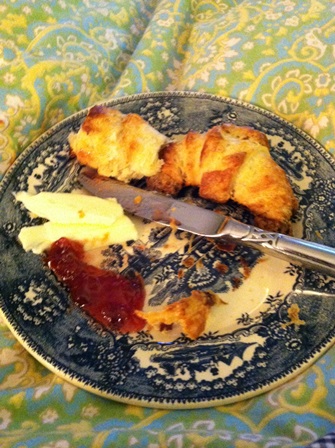
A luxurious breakfast in bed of homemade croissants, Kerry Gold Butter, Amy’s local strawberry jam, coffee and the kids sleeping late.
John Malik is an award winning chef in Greenville, SC. Along with his wife Amy, they owned and operated 33 Liberty Restaurant from 2001 until 2008. Following that he was Executive Chef at two upscale retirement communities in the Greenville area. John has a BA in English from Southeastern Louisiana University and has written for Smithsonian Air & Space, Saveur, The Greenville News, Greenville Journal, e-Gullet and has been featured in Southern Living, Bon Appetit and Chile Pepper magazines. John holds the whimsical title of Kingsford Charcoal Flame Master and was named Who’s Who in America Barbecue for his sophisticated take on traditional smoking. While 33 Liberty was open John hosted the entire team of Michelin’s “Red Guide” inspectors for a private meal and lived to talk about it.
John has made numerous guest chef appearances including the Food Network, Fox & Friends, the International Food & Wine festival at Disney World, Great Chefs of the South (Beaufort, SC) “Fixin to Eat” a Salute to Southern Chefs (Paso Robles, CA), the Epicurean Evening (Los Angeles, CA) Charlotte Shout! (Charlotte, NC), Drager’s (San Mateo, CA) and Greenville’s own Euphoria.
While important to remember that he IS a serious chef, most recently, after undergoing major knee surgery, John let the best of his cabin fever get to him and imagined himself as the mayor of his Upstate city…and he was kind enough to drag our editor on his fictional written journey before pondering who has the state’s BEST pimento cheese.
PHOTO CREDITS: John Malik