CRESCENT PEOPLE: Our Fingers are Crossed for Chef Craig Deihl
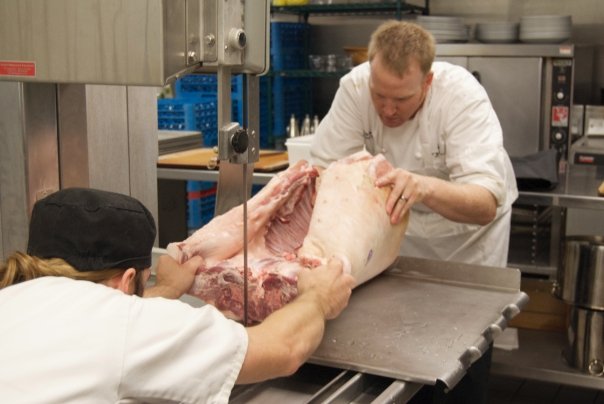
Just hours after CRESCENT publishes this segment of our feature on Chef Deihl, he and the rest of the culinary world’s best will trade in their chefs’ whites for black tie and converge on New York City’s Lincoln Center to celebrate the best of the best in the industry at the James Beard Foundation Awards.
Chef Craig Deihl is among the five nominees for “Best Chef: Southeast,” and we wish him well.
UPDATE: Chef Deihl came close to winning, but in a year where the competition was tighter than most, he was edged out in a tie by Chef Hugh Acheson who owns Five and Ten in Athens, GA and Chef Linton Hopkins of Restaurant Eugene in Atlanta. Acheson, who also took home top prize in the “American Cooking” category for his book A NEW TURN IN THE SOUTH: Southern Flavors Reinvented for Your Kitchen, spent part of his childhood in Clemson. Congratulations from CRESCENT, Chef Acheson. We also want to congratulate South Carolina’s other nominees including finalist Craig Deihl and semifinalists The Macintosh in Charleston for Best New Restaurant, Sean Brock of McCrady’s for Outstanding Chef, and for Best Chef: Southeast, Jeremiah Bacon of The Macintosh and Ken Vedrinski of Trattoria Lucca in Charleston.
—————————
The whole farm-to-table movement seems to really be picking up steam. Do you think that something like farm-to-table really benefits cooking in South Carolina?
It is kind of comical that, if you didn’t know it, and a lot of people don’t really know it, how many different farmers are in the outlying areas. You don’t have to search hard to find them.
Right.
And a lot of people…I don’t think they really understand that. Like we have such tremendous producers within our state that we don’t have to go far to find it. Now you do have to trudge through some of the people that are raising product to raise product and get to the farmers that are really raising product…crazy, old world lines or buying beef to raise on pasture that is a staggered program, and while taking in the best interest of the animal, to make it produce better beef – type scenarios. We’re pretty fortunate to have some really unbelievable farmers in our back yard and we’re probably first and foremost here in Charleston, knowing that in Kingstree, Seth Harvin’s got one of the best processing plants that I’ve seen just about anywhere. It’s a pretty impressive thing that we have, and I can tell you for these old heritage lines of meat, the preservation of the product in which it stems from having a good processor. Williamsburg Packing, that’s the name of their plant, is a huge, huge avenue for us to get what we’re getting, as well. So not just having a great farmer but having a great processor and then farmers being able to get those great products back to the chefs. It’s not easy and it definitely isn’t a cheaper sense than buying from a high end, well-raised commodity line coming off of a truck.
Don’t you think that people are appreciating that, though? I mean, they’re appreciating that quality. They’re appreciating that care because they know they’re getting a better product.
They are expecting more and I think that, in a lot of cases there are some people who are using who are using the idea of buying local as marketing tools. I’m not in it for marketing. I come from an area of Pennsylvania that…What’s local? You grew it in your back yard and you grew enough of it, you had your whole family get together, which, if your family was as big as ours was…my mom’s family, she came from a family of seven… My grandfather had 95 acres. We’d all get together a corn roast, then we’d blanche it and chill it and cut it off the cob and pack it in Tupperware containers. Everybody would have it in their freezer. Same way with peas and butterbeans and limas and pole beans and green beans and tomatoes. All this stuff was either canned or frozen. Every member of the family had 2 chest freezers, one for vegetables and one for meat and fish. That’s how we lived, and that doesn’t really go on any more. I always looked at it like, when we started buying out the back door at Magnolias and I was seeing some of the prices, I was like, “ARE YOU KIDDING ME! I’M PAYING THIS MUCH FOR THIS?” I grew up in Pennsylvania and you know what the cost of seeds were and the work that went into planting it and nurturing it and going out and having to pick the weeds and run the rototiller and all that. I mean, I’ve done that.
That’s honest-to-goodness work.
And I can tell you that I’m not a farmer, and I don’t want to be a farmer, but I want those products from those farmers that do value that as good, honest work. And I think that’s where my goals lie, — coming from an end that already knows the difference between…I’m trying to think of the best way to put it … I can see through all the nonsense and know that what we’re buying is because we want quality. The better quality I can provide you, the less I have to do to it and the better tasting the food is when you taste it, but I’m sure there are chefs out there that can buy from the same sources that I can and not make it taste as good.
I would almost guarantee that.
I’m sure there are a lot of chefs out there who want to buy from the same producers I buy from because it would be buying from the best…the best in our region. Yet when they go and they work with it, they don’t work with it in the same way I do, or they don’t fully get their added values out of it. That came, for me, from making a lot of mistakes. Like making collard greens then trying to figure out, “Why are these sweet at this time of the year than they are at this time of the year, and how can I make them taste the same as they do at this time of the year when they’re not as sweet?” And that’s when we started to use molasses, some old school techniques and doing some more research on it.
Experimentation and having fun.
Yeah, but I run a kitchen that’s based off of learning by making mistakes. Making mistakes in a general idea of, “Hey, as long as you’re going to make a mistake and it’s not going to cost us money and I can catch it in time where we can correct it.” That’s how you learn. You learn by making mistakes, and at a rate at which you make mistakes faster than everybody else is how you’re going to get further and far beyond. It’s saying, “Hey, I made a mistake but I realize I made a mistake. I want to get better.” That’s the way I feel like I run the kitchen. Because we want to do something new? We’re all going to learn together, or I’m going to make a mistake in the morning, and by the time they come in in the afternoon, I already knew what went wrong and I show them the right way of doing it.
Switching gears, you created your Artisan Meat Share program that allows people to enjoy some of the salamis and cured meats that you’re making and serving. What gave you the idea to implement that for the public and what kind of response have you gotten? How can people get involved or do you have any plans on expanding it to a full line that might be available in the specialty retailers?
Oh, you just…You ask all kinds of good questions, don’t you? (Laughing)
I don’t know if they’re good. I’m just curious.
Well, you’re asking a great stem of curious questions. We started to buy pigs, and then we were like, “Oh, we always have this bit left over from the hams. Let’s try to make a salami.” And then we started to realize, “Hey, when we bring in a whole beef, we have the same amount of product on a grander scale.” And we started to use the pork fat to make beef salamis with pork fat that were turning out unbelievable. So we were whole utilization of the entire product, and then we acquired an entire walk-in freezer full of stuff. I don’t mean “freezer” as in frozen. We converted the freezer to our curing chamber. So I had a few thousand pounds of product back there, and I’m like, “There’s no way this restaurant is going to sell it the way in which I’m producing it, and it’s just by-product.” But I got really good at taking that by-product and turning it into a really good finished product. So I was like, “Hey, these guys out in San Francisco…” I kind of bootlegged their idea. Boccalone. They started a Salumi society. I thought, “Well, if they can do it, we’ve got CSA (Community Supported Agriculture) programs all over here in South Carolina, and a lot of them local here in Charleston. We’re buying from local craftsmen who are raising great beef and great pork and great turkeys, and instead of giving you the exact same product every single time that you get in a CSA, let’s always have something different in there and open it up to say, 100 members at 3 ½ pounds at a time four times a year, and let’s not lose sight that we have to be able to provide that a year from now and however long we want to. We did that for two years. We didn’t reopen it last year. The restaurant got busier and we needed to produce enough for the restaurant, so we stopped doing the CSA, but we still do holidays. We did Christmas, and as we get into Father’s Day, we’re going to do Father’s Day. As we get into Memorial Day weekend, a great grilling weekend, we do one — a barbecue pack for doing outdoor grilling. We want to do one for Father’s Day that’s kind of based on that same principle — maybe more steak-conscious and develop a price point that we can still buy from our great local source, whether pork, beef, or what have you. We can provide a great source to people that don’t have access to getting these products, other than through somebody like us, because there’s not a local grocery store that sells local meat that’s heritage-raised or pasture-raised. And that’s kind of my goal…my goal is to develop a demand for it and then expand the Artisan Meat Share around it.
And how can people find out when you are opening those offerings? Will that be on Cypress’ web site or the Facebook page or your web site?
Yeah, it’s pretty much through the Facebook page and members. They can email cypress@hmgi.net and ask to be added to the mailing list so, when we do open up offerings, that they be included. But, at this time, we’re no longer doing the yearly shares.
You know, at some point, you really can get fine dining fatigue, and going for some simpler fare just is what you want.
Exactly, but there is still no reason why you can’t still provide a fine dining spin on it, and that fine dining spin is, “Hey, if I can have a restaurant that is fine dining — Cypress — and within the confines of Cypress, you’re going to find local…” Right now we have local pork chops on the menu. We don’t always have local pork chops but if we were bringing in enough pigs within a retail market where I could produce “American Junk Food,” I’d have to have a place to sell pork chops and I’d have to have…the hams going into hams and salamis and now I’m producing American junk food once again. Ham sandwiches, Amish Swiss cheese, really good house-fermented mustard, maybe some sauerkraut. Same way with beef – doing brisket and whatnot. Reubens. And the restaurant is selling the middle meats everybody wants every day of the week. I’m providing the outlet where things need to go, the way in which they need to go or you open it up to “Hey, we’re going to put a great big wood-burning grill on the back patio and we’ll cook your steak however you want.” Buy it, bring it out back, cook it up, sit down on a picnic table and have dinner.
That sounds amazing, by the way.
How much better does an idea like that get? I’m full of ideas of trying to stimulate great food within a local-driven community that we don’t have access to. I don’t want to sell frozen meat. I want to sell fresh meat. I want to be able to look back in there where’s somebody’s cutting and see a side of beef hanging on a hook and know that meat came from a local producer and the meat is tagged like, “This is Keegan-Filion Farms. This is Carolina Heritage Farms. This is Righteous Ranch.”
- Follow Chef Deihl on Twitter at @cdeihl.
- Visit his personal website at therealdeihlchef.com.
- Visit Cypress online HERE.
Stay Tuned for Part 3. For Part 1, Click HERE.