CRESCENT People: Kelly Tilghman. From North Myrtle Beach to Golf Channel’s Lead Anchor. SC Remains “First in Golf.”
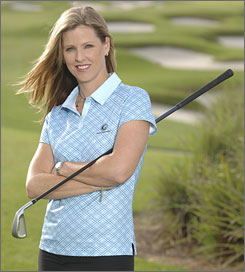
She played golf for Duke and as a professional overseas. She was one of the original Golf Channel team and now works as the lead anchor for the network’s PGA broadcasts – the first female lead announcer in PGA history. She’s North Myrtle Beach’s Kelly Tilghman, and she recently sat down with CRESCENT to talk about the Kelly we don’t see on Golf Channel.
In the first part of the series, Kelly talks about growing up in North Myrtle Beach, her family’s golf lineage, why she left professional golf, and how she “tripped through that door” to initially get in to the broadcast booth.
You really are the face of the Golf Channel, but there is not much out there about Kelly from North Myrtle Beach. There is a lot out there about Kelly Golf Channel, but who is Kelly from North Myrtle Beach?
Born and raised in North Myrtle, in that little section of town right around 11th Avenue. Basically lived in one square block my entire childhood life there until I was 17 and went to college. My father was a politician who also co-owned and operated a golf course for 22 years called Gator Hole. I worked every odd job there. The game was kind of spoon fed to me in that sense. I always had access to it. I also lived on the 3rd tee of a semi-private club called The Surf Club. So I had a lot of access to golf. My mother worked in the radio business for WKZQ. She was in sales and advertising and she is still in sales to this day. She works for Sunny Day Guide now, for 25 years she’s been working there. Long time. Valued employee. My parents were very plugged in to this city. Ambassadors, if you will. Very social, very involved in politics and all kinds of activities that were going on there. Sun Fun Parades, etc., etc. So we were definitely an out-and-about family.
I also was a big time beach kid. Love to surf. We went to the beach every weekend. But golf my primary sport. That and basketball in high school. We had a great basketball team and won the state championship my junior year. So between golf and basketball, I was an extremely outdoorsy, athletic kid. Kinda of kept me out of trouble. So that’s a brief description of life there in North Myrtle Beach.
But just one step further, my roots also come from Columbia, South Carolina. That’s where my mother is from. Her family is the Hemphill family and my grandfather, Melvin Hemphill, was a 47 year teaching professional in Columbia. He and his sister, Katherine Hemphill, are in the South Carolina Golf Hall of Fame. Him for teaching. He actually worked with Jack Fleck before he won the U.S. Open. Worked with a couple of other players before they went out and won their respective majors. Neat story with him. And Katherine Hemphill was on the Curtis Cup team with Patty Berg and the likes of players like her in the 30s. I believe it was 1938. Great golfer in her own right. Strong amateur player. Hung out with Babe Zaharias and all these great players. Many of the founding members of the LPGA. Yeah, golf is in my blood. I would say I’ve got a few drips of the great talent they had pouring out of their faucet, nonetheless, that’s how I got started in the game.
You played professionally, overseas. Why did you leave competitive play?
Annika Sorenstam. Pretty simple. I was paired with her in a collegiate event and I didn’t even know who she really was when I was paired with her.
I played for Duke, she played for Arizona. We were grouped in threes with Tulsa, as well. All three schools playing together. This little blond hitting it 2 clubs longer than me, but she was probably 4 inches shorter than me. Didn’t say a word to either of us in the group the whole round. Shot in the 60s. At the end of the round, I had to ask her how to pronounce her name and she told me. She said “Annika Sorenstam.” I said, “I’m going to have to remember this name.”
My first pro tournament was the Australian Ladies Open in 1994 at Royal Adelaide in Australia, hence the title of the tournament, sorry. That was Annika’s first pro win and I thought, “I can’t shake this woman. She is good.”
So that said, I kind of knew what my competition was like. It was tough to make a big check if you weren’t finishing in the top 20. I made some cuts. I made that one. Made a few others on the European tour. Got my card there. Tried LPGA Q School couple of times. I kinda wasn’t getting it done.
So after sponsorship ran out, I had some local investors from North Myrtle Beach that were pouring money into my account. I could only pay them back incrementally and certainly wasn’t paying them back nearly what they were paying me, so I had to come to the realization that this was a short-lived dream and it was time to get real and move on into a different direction.
So then you moved on to broadcasting. How did you get your foot in the door? That’s a big switch — going from competitive play to broadcasting.
I tripped through that door. It was not intentional in the slightest. I had walked away from the game in ‘96 after the Asian Tour, hung up the clubs.
I had hit balls every day in my life since I was 13. Probably didn’t miss a day. I took about a month off and finally I started kinda wanting to hit some golf balls, so I went out to a driving range and there was a man there who just caught a look at my swing…caught a glimpse of my swing and came over and started watching me hit balls.
He said, “Are you on the tour?” I said, “No, I’m done trying.” He said, “Really?” We talked for a little bit longer and he said, “I can’t help but notice you have this distinctive voice. It is authoritative. Have you ever thought about sports broadcasting?” I said, “Really never.” He said, “Listen, I used to own a broadcasting firm and I’ve got some connections and if you’d like to get an internship at a local station, I can hook you up. You’d have to work for free but at least you’d get to see what it’s like. Maybe put together a resume take and see what happens.” I thought about it for a couple of days and finally gave him a call and said, “You know what? I’m interested.”
So he hooked me up with a local NBC affiliate in West Palm Beach and I worked for free for 2 weeks, shadowing the anchors. I was their gopher. Turns out they kind of liked what I was doing. They started out paying me $5 an hour and after 6 weeks, my time was up.
I made a really, really, really bad resume tape. Gave it to a guy at a Media Day in Port St. Lucie, Florida. A golf Media Day. He worked for The Golf Channel. He took it back. They took a look at it and called me and said, “Come on up in Orlando. We can’t put you on the air just yet, but we like what we see. We’re going to start you in the video tape library.” And that’s where it all began. I was working in the library, checking in and out tapes for people who knew what they were doing. I didn’t have a clue. I didn’t know the difference between a VHS and a Beta. But slowly, I started to learn the difference and that’s where it all began.
Stay tuned for Part 2.