MADE IN SC: A Tie is a Win for R. Hanauer
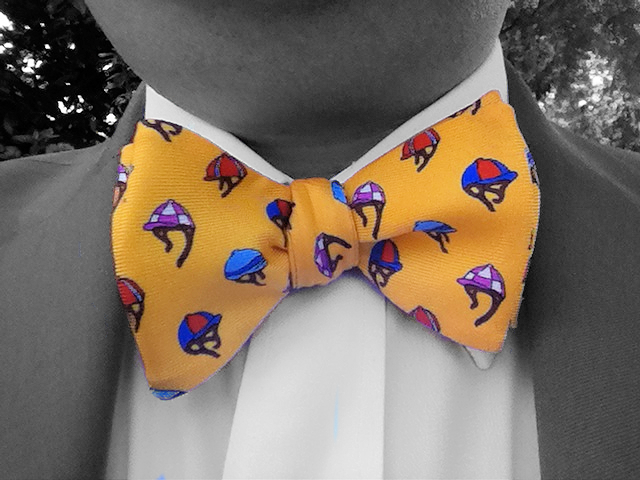
Food Network’s Alton Brown took to Twitter last year with a perfectly good question. “The question isn’t why do I wear bow ties, the question is how can you be so uncool as to not wear bow ties?”
Randy and Jayma Hanauer who started R. Hanauer in the mid-1980s, ask the same question on a regular basis.
A boy from Indiana who found his way to New York City and migrated south quickly realized that the grass was greener on the other side…of the state line.
Starting with one employee with an expiring visa who would sew in her home, R. Hanauer expanded to a couple of employees and 1200 square feet and then to ten employees and 5000 square feet.
Today, R. Hanauer has become one of the nation’s most recognizable brands of bowties – and it’s made on Main Street in Fort Mill.
—————————
You found Fort Mill.
RANDY: Found Fort Mill, well, how did we find Fort Mill? We found Fort Mill when we started this business, which was in 1985. I bought a simulated hand roll machine to make the pocket squares, which is how we got started in business and I had a lady, her name was Gabby, a German lady in Charlotte, and she would cut and hem the pocket squares and finish the corners by hand. And she went home to Germany to visit her family and couldn’t get back in. Her visa was up. So there was my machine at her house and I didn’t know how to get ahold of her. And she got ahold of me through another German friend and suggested a lady, Karen, in Rock Hill, South Carolina, that would sew our pocket squares for us. So, with the help of another friend, we got in her house and got our machine and took it down to Rock Hill for them to cut and sew our pocket squares. So from our house, we have to come through Fort Mill to go to Rock Hill to get everything cut and sewn down there. I thought “Boy, this would be a great little place to have our workshop here if we can ever get that far along.” So, after a year of that, I guess… Jayma, when did we…let’s see, we moved into Tom Hall Street, that was in ’89, is that right? Right after the hurricane.
JAYMA: It was in October after Hugo, a month after Hugo hit.
RANDY: Right. That was when…
So there was still a lot of debris to clean up at that point.
RANDY: Oh yeah, …
JAYMA: We’re still cleaning up.
RANDY: Back in the woods, we’re still cleaning up.
Really?
RANDY: Yes. So, that was ’85, yeah, we went back and forth to Rock Hill all that time and we started making bow ties down there also. And then a place became available out on 160, on Tom Hall Street, 1200 square feet and we moved in there in October of ’89.
How big of a facility do you have here now?
RANDY: We’ve got 5,000 square feet here and ten employees.
What was your background prior to starting the company?
RANDY: When we moved to Charlotte, I had lived in New York City for three years and worked for Corbin…great, great trouser manufacturing company. That was the greatest trouser line. If you had a high end men’s specialty store, you had Corbin in the store just like you had Gantt shirts and Southwick clothes and all those wonderful old names. So I’d worked for them and I wanted to round out my resume and get some selling experience. Working in New York, I worked with retailers all over the United States and the ones that I liked best were all in the South so I decided I needed to get some selling experience. Norman Hilton had just started a new division, and Marley Hodgson had just started a new belt line called Trafalgar, so I took those two lines, and I had a little neck ware line and a little sweater line and we moved to Charlotte. Brand new companies. Didn’t even think about…all straight commission. Working on a draw. Didn’t have any money. Peter Strom, the Executive Vice President of Hilton, signed so I could get a lease car in Charlotte. And I went on the road, started selling and I remember coming back from Washington, DC one Friday night and thinking “My God, how am I ever going to pay this MasterCard bill off?” It was very sobering. But worked hard, sold, got delivered and it worked. It worked. Just hard work and perseverance. The John Gilbertson thing didn’t last very long but then my good friend Crit Rollins that lived in Atlanta that was the Hilton rep moved to New York, so I just took the Hilton line from him, which was a very, very prestigious thing in those days. So, with Trafalgar, the belt company, I represented them for 38 years.
Really?
RANDY: 38 years and then they were bought out by a big company so I left.
And then you decided to…
RANDY: Started this in ’85 and it just takes so long to build a company with no debt. I mean I travel all week long and Jayma would be in the office. She was here every day making sure everything got made and shipped. I’d do all the design work and all the selling work and I’d be on the road all week long selling this stuff and selling my other lines. Gradually, I’d drop off a line, drop off a line and I finally got down to where I just had a couple and this finally got big enough where we could make a living at it.
Now that you’ve done that for a while…there are several up and comers in the state who are trying to do what you did in 1985 in starting their own clothing company. What advice would you give somebody like them?
RANDY: I can’t give them any advice. It’s just a lot of hard work and perseverance and you’re going to be down-and-out and depressed sometimes but you’ve just got to keep going and tomorrow might be a better day.
When you branched out from the pocket squares in to bow ties, where did you decide you were going to come up with the style in terms of cut and thickness?
RANDY: Two things. First of all, we cut all of our bow ties on the bias and that is why they tie better than everybody else and we use a really good interfacing. It’s a poly-cotton interfacing that restores the shape of the tie after it relaxes when you take it off your neck.
Not everybody can wear a bow tie, but we’re starting to see an increase in their popularity. When you started, certainly the market was probably smaller. What made you believe that the market for bow ties would grow, or were you just content with being a major player in a smaller segment?
I was content with being a major player in a smaller segment, but this generation of people, young people, that are juniors and seniors in high school now and in college is the first generation in fifty years that has cared about clothing. Up until now, these kids in college, they looked awful. It was just jeans, flip-flops and t-shirts. They didn’t even think about trying to look nice. When I was in school, that age, we all wanted to look great, great. V-neck sweaters, great trousers, plaid trousers, and a lot of us worked in men’s clothing stores and followed that all the way through our life. Worked for a men’s clothing store and then maybe you got a job with a clothing manufacturer. I mean, that’s how a lot of people in my generation got started in this business. And you’re seeing that happen again with these young people in college. They get out of college and there are no jobs, so they think about…they’re entrepreneurial and they think about a business. I met a young man in Columbia this weekend. He’s graduating law school this May. No prospect of a real job so he’s buying things on the internet. He’s got his own web site, brings them in, refurbishes them, sells them over the web site…resells them. And he’s making money. He’s having fun. There is no telling where that will lead him to.
Tip for Maintaining a Bow Tie:
No matter how much you shave, if you still have scratchy stubble on your neck that pulls fibers out of the tie where your neck rubs against it, one solution is to use a disposable lighter to burn off the fibers (while not wearing the tie and being careful only to burn the exposed fibers – not exposing the tie itself to flame).
According to Randy Hanauer, “That really, that kind of cauterizes and keeps it from happening more. You can take just a pair of sharp, small scissors and go through and trim off those fuzzy things that come up. But the match, and I hesitate telling people that, because they might set their whole tie on fire, but if you’re very careful that’s really…because the silk will go back in there and it kind of seals it off so it doesn’t happen as often.”
- Follow R. Hanauer on Twitter at @rhanauer.
- Follow R. Hanauer on Facebook HERE.
- Visit R. Hanauer online HERE.
Stay tuned for Part 2, and later we’ll see one of Randy’s ties come to life just from an off-the-cuff question.