CRESCENT Products: SARGE Knives — Working to Find Those Initial Niches
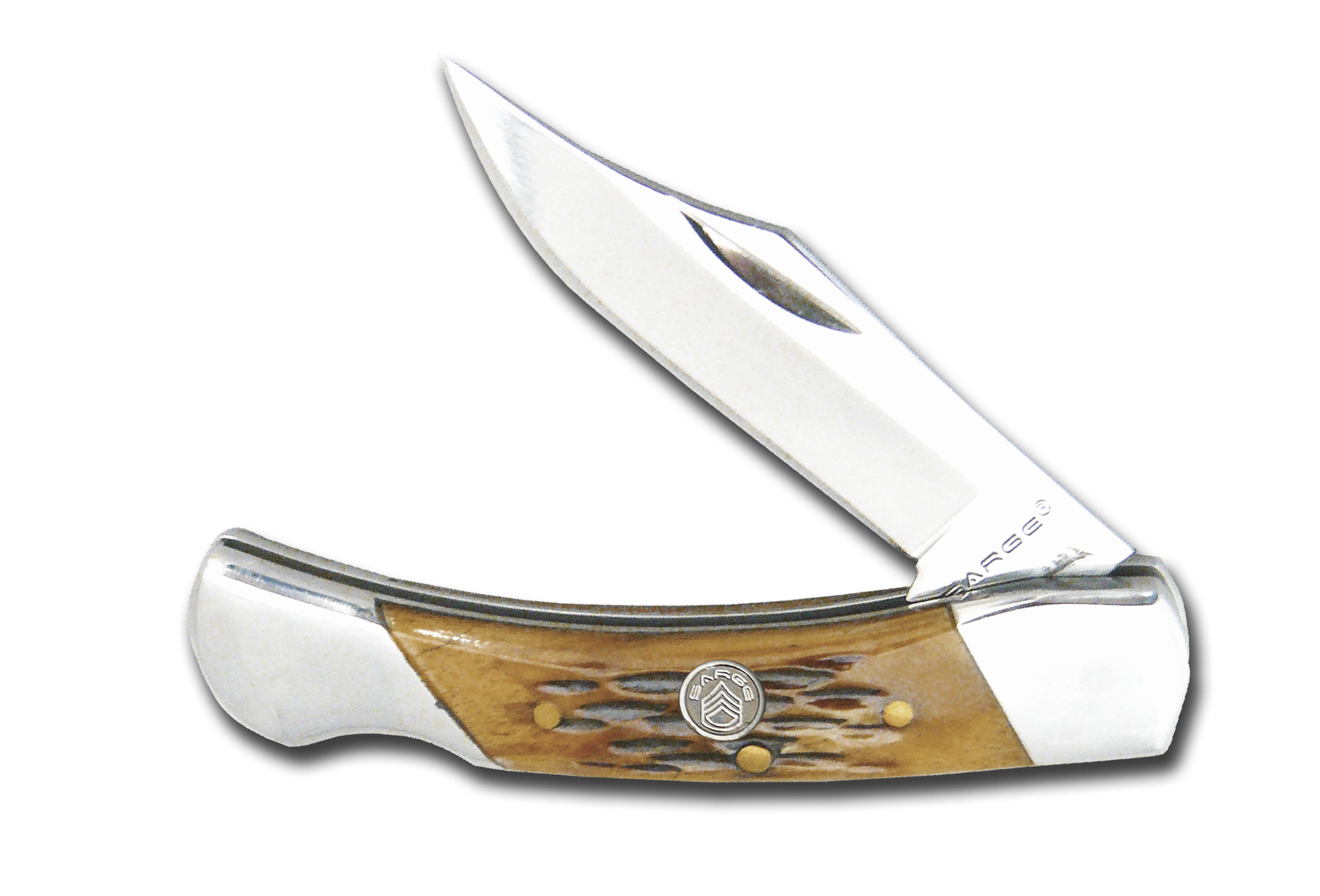
Last week, we met Gene Morris when he burst in the room laughing. This week, we get a sense of why the Morris patriarch ticks the way he does and why SARGE keeps growing. As Gene said, “One advantage I have is that I don’t have an education to overcome.”
He runs his business on common sense.
—————————
How’d you get roped into working with dad? You’ve been at this for a while, and you’re still talking to each other.
GENE: Well, I’ve got 3 of them and all 3 work for me.
MATT: I think he tricked me. He was like…when I got out of school, I had a part time job and he said “Well, I need some help in the afternoons. If you can just come in for a couple of hours and help me out.” So I started doing that that and it was “Well, I sure could use you for a little bit more time.” He goes “What are you making over at that other job?” He was like “I’ll match what they’re paying you.”
GENE: It was a tough job market right then.
MATT: So I started coming over all day and that was 20 years ago.
What were you doing before you came to work with the family?
MATT: Yeah, I was wanting to get into sports marketing, interviewing with all the race tracks, Hendrick Motorsports and those guys. Charlotte Hornets.
GENE: It was just a real tough market and he just kind of got in here and got us settled. Later, his older brother came in and, after that, his younger brother came in.
So, it’s a full-family shop.
GENE: Yeah, he (Matt) runs the knife business, which is a totally different business, different P&L. His older brother runs our manufacturer’s rep business and his younger brother does all our engraving and radio repairs and things like that.
And you’re not stepping on each other’s toes?
MATT: I’ve heard of all the nightmare stories about family business but we’ve never had an issue…
GENE: Not to say that we’ve not had issues, just not family business issues.
MATT: We’ve been working together for twenty years now.
GENE: Actually, what we had was co-op money. The manufacturers provide you money to grow sales any time you need men or anything you need to do to get extra sales. So we were trying to grow our epoxy business, and epoxy comes in tubes, and there are six tubes in a carton. We were trying to grow that by having a sale. So guy comes in and says “Can I have 2 tubes of epoxy? Just need 2.” Next guy comes in. “I need 3 tubes of epoxy. I don’t need 6. I just need 3.” So we bought some pocket knives and created a little flyer. A fella comes in and asks for a tube, same question. “Can you use 6?” “No.” “Wish you could because you get a free pocket knife if you do.” “Oh, man, we use that all the time, just give me 6.” Same thing when the next guy needs 3. Then the guy shows back up in a few days and says, “My son took that knife. If I buy 6 more tubes of epoxy, can I get another knife?”
The hardest thing to do in sales is change behavior. He might buy 3 times a week, but he always bought 2 tubes. It also worked when he said, “I’m using a competitor’s brand. I’m using X and you’re selling Y. I don’t want to change.” “But ours is better, it doesn’t smell as bad and it holds better and it cost $0.50 less a tube.” “No, I want X.” Then you offer him an incentive. “What’s in it for me? I’ll try it. Sounds like it’s a good product.” Well, they don’t go back to their boss and say, “You know I bought this stuff because I got a free pocket knife.” He goes back and says “You know, this stuff doesn’t smell like that other does.” So he starts repeating your sales pitch on down the line. So that’s the way it really started. We had no name, no box, no manufacturer, no nothing. And we were just buying other people’s products. And our first order…we came up with a name. I wanted something that had a military ring that wasn’t para-military. The Gulf War was over, and we didn’t want our name not to work. So I came up with Sergeant and checked it with SARGE because everybody had a SARGE. Everybody respected the SARGE. He was a very utilitarian, get-it-done type person and would be well-respected. Then we checked in the logo standpoint and all that was available as long as you didn’t use it in any type of official capacity. If anything has been in the public domain for one year or more, it becomes “prior art.” You can use it. So we took the basic Master Sergeant logo and colorized it and that became our logo and then Matt developed a box. We just kept trying different things. He’s always been artistic and he came up with the design of the name. So we had the logo and the name. And it really did what we wanted it to do because people would say, “You know my father has a SARGE knife or my grandfather had a SARGE knife.” Well, we must have only been about 4 years old but they’d heard the name and they’d seen a form of a logo and it was iconic and they back it in that they have seen SARGE all their life. They haven’t seen that logo. It wasn’t on a knife, but it worked and when…
They had a built-in familiarity.
GENE: Yes, yes. When the brain sees that, it says, “I know that, I trust that.” And it doesn’t have anything in the way of a negative connotation. Most people do respect the rank of Sergeant. They know that as a performer, not a fancy deal. Our knives, we always promote them with “Value, not ego.” That you don’t pay for a fancy name, or something like that. Certainly not to downgrade Case, but you pay for something when you get Case. You’re not sure what it is because our products are every bit as good or better as far as the way they’re made. The quality of the steel. But the Case name, because of the corporate entity and everything, you pay for that. And we just say “Value, not ego.” And by having a blank sheet of paper, it allowed us to do a lot of things. Most knife companies come in and start a knife company and “I want to be the #1 knife in the knife shop. I want to have the best steel. I want to have the most unique handles. I want to do this, I want to do that.” That’s not bad, but that pigeonholes you to a certain place. Or another guy says “I’m all about the wildlife. I want to have every knife you can possibly have for wildlife.” That’s not bad either, you’ve got your niche. So when we come in, we just embraced it all. We might be doing 10,000 knifes today Carhartt. We might be doing knives with their name on it. When you buy a jacket, you get a Carhartt knife. Ford Power Stoke Diesel, Milwaukee Electric Tool. That’s a big part of our business. We might be working on knives for National Wild Turkey Federation, Ducks Unlimited or any of those people. We like the wildlife. At the same time, some of our best customers, especially early on, were in the hardware store business with displays so we developed our own displays. Now, one of our latest things, we’re into the gift business. We have a lot of friends who want knives for their sons to give away as grooms’ gifts.
From that it went to the steak knives for wedding gifts and the premium gifts. So we are more about the niche. I always say, “Riches are in the niches.” You don’t make no money where everybody’s at. There ain’t no money there. It’s worked out well for us. Yesterday, I flew out of Atlanta and had a car pick me up, take me to Lakeland and waited on me and I called on an automotive two-stepper that’s big into the tool trucks and everything. We’re in the automotive, what fits in there. We really just don’t have any limits and one thing that’s allowed us to grow more than somebody that’s just starting is because we have the base business. We have our manufacturing rep business, we have our two-way radio business and we have here (SARGE). So it allows me to have resources that somebody who’s just starting out working out a knife business, they couldn’t afford to do some of the things we do. It would be impossible because of the income stream unless they’ve invested a ton of money and are willing to go backwards for a long time.
So this was just a natural dovetail on what you already did.
GENE: And we always looked at it like that. When we started Morris Marketing Group, it really was such a joke because it was me and an old van and I was the “Group.” I used to get a lot of kidding “Where’s your group?” “They’ll be here.” We grew that into a very successful business and is still a very successful business and continues to grow. It allowed us, when we had the opportunity to go into the radio business, that we could put every dime we made in radios and more back into that business to make it grow exceptionally fast, where somebody who was just in the radio business and had to live out of it and feed everybody out of it, they couldn’t do it. So Morris seeded that business. So when we started the knife business, it allows us to do things in the knife business that other people just couldn’t do, wouldn’t know how to do, and couldn’t fund because we don’t have to take any money out of it.
So where does SARGE go from here?
GENE: It’s going to double in 18 months and then it’ll double again.
And you don’t hesitate when you say that.
GENE: Oh, no. There’s no shortage of opportunities. Out biggest holdback is quality people and my personal theory on growth. You don’t grow on borrowed money. You grow on money you make on reinvested properties because if you grow on borrowed money, you can grow fast but then you grow inherent risk that if you hit a bad time like we did a couple of years ago. Not only can I but my family and 28 more families lose everything they’ve got. So we will grow as fast as we can grow with people and fund our business from the profits. We have exceptional growth in every business, over 20% last year. At the same time, we were able to reduce debt even as our receivables and our inventories increased 40%. And that’s just a personal thing. That’s not something some advisers told us. That’s finally my high school education paying off. One thing I tell people is one advantage I have is that I don’t have an education to overcome. We really run our business on common sense. Two and two really is four. It really doesn’t matter what Wall Street wants it to look like, it’s still four.
Kids come out of school saying, “Well, it didn’t say to do THIS in the text book.” Well, a text book isn’t real life.
GENE: You go to school and theoretically, everything works. But the implementation and the practicality of applying that is very, very difficult. And many of us have played Monopoly before but very few of us played the game with real money. Almost none played it with their money. So protecting capital is a big part of being a successful business. Most everything we do, we do ourselves. Just like this catalog, every piece of this is shot ourselves. That’s $20 worth of fabric from the Army-Navy store. That’s shot with our own camera. Every piece is laid here, every piece of verbiage, everything you see in here is done in here. We just send it out on a disk to be published. Most catalogs you see like that are not done internally. You know, that’s how focused we are about doing things ourselves and owning it. Any machine you see in this building, any equipment is paid for. We haven’t always been able to do that but we are very conscious about it.
But it allows you to control the quality of the product you put out.
GENE: It allows us to control the quality and it allows us to manage risk. When business went south in ’08, we didn’t have to lay anybody off. Now, we bled for a while, but we made a very conscious decision then since we did have financial help that we could absolutely put the pedal to the metal on all our businesses and take market share where everybody else was cutting out, cutting back. It’s funny, when I started, people would say “Well, you don’t know nothing about a knife business.” That’s funny you say that, because that’s true. All the people I’ve been dealing with buying knives from don’t know anything about it either and I can do as good or better job than they can, I can produce a better product. And we don’t see any place that it stops. I don’t think my neck knife is out here now. We’re constantly looking for new products, new ways to do it, new markets.
Stay tuned for the final segment. For Part 1, click HERE. For Part 2, click HERE.